For many people, the understanding seems simple: once you install solar panels, you’ll never have to worry about paying an electricity bill again. It sounds ideal, almost like a lifetime ticket to free power. But it isn’t really the case.
Installing solar panels does bring savings and cost-cutting, but the actual impact depends on how you use and manage your energy. You must understand how the solar panels work, how they cut costs, habits that maximise the solar gains, and then mistakes to avoid to extract the maximum potential of the solar panels installed on your rooftop.
We’re confident that you are here to gain clarity on this, and the blog will act as a complete guide on how you can maximize your savings by utilizing solar panels.
Why Solar Panels Are a Smart Way to Save Electricity
Think of your electricity bill as a monthly rent you pay to the power company. No matter how long you’ve been paying, you never actually “own” anything; you just keep sending money out the door. Now imagine if you could build your own little power station on your rooftop. That’s exactly what solar panels do.
Solar panels capture sunlight, a free and unlimited resource, and turn it into usable electricity for your home. The more you use your own solar power, the less you need to buy from the grid, and the smaller your electricity bill becomes. It’s like growing your own vegetables in the backyard instead of buying them every day from the market; you cut down costs while enjoying something sustainable.
Another reason solar panels are smart is their long-term impact. Once installed, they can generate electricity for 20–25 years with minimal maintenance. Imagine locking in your electricity costs today and being shielded from rising tariffs year after year. While others worry about bills going up, your solar system keeps giving you free power from the sun.
Here’s an example for your better understanding:
Suppose a family installs a 3 kW solar panel system. On a sunny day, it generates enough electricity to run fans, lights, TVs, and even kitchen appliances. Every unit generated is one less unit taken from the power company. At the end of the month, the family sees their bill cut by up to 50–70%. Over the years, these savings add up to lakhs of rupees.
And it’s not just about money. Using solar power also means you are using clean energy. That’s like switching from plastic bags to cloth bags; you’re making a choice that’s better for the planet and future generations.
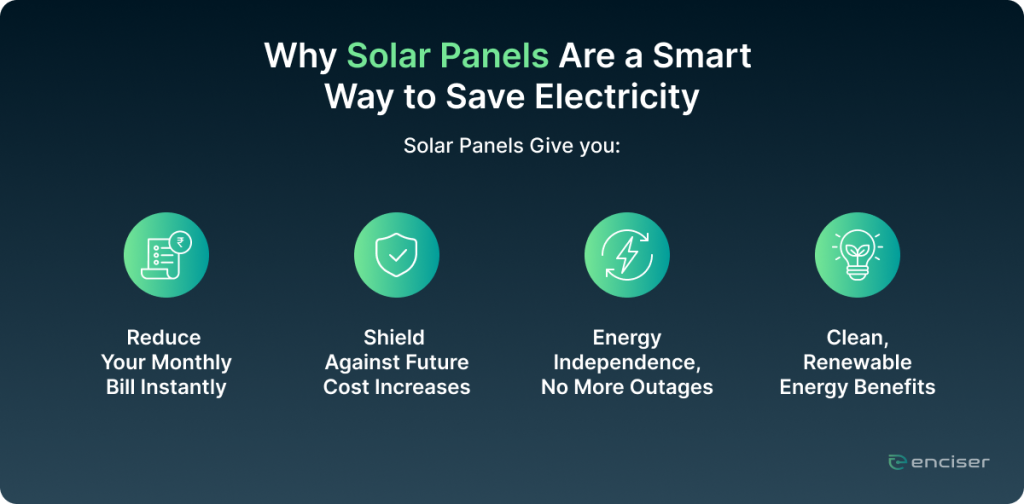
In short, solar panels are smart because they give you:
-
Immediate savings on your monthly bill.
-
Long-term protection from rising costs.
-
Energy independence, reducing reliance on power cuts or fluctuating supply.
-
Environmental benefits, since sunlight is clean and renewable.
Once you understand these benefits, the next logical question becomes: “How much can I actually save, and what factors affect it?” Let’s break that down in the next section.
How Much Can You Actually Save with Solar Panels
Not every household will save the same amount of money after installing solar panels. Think of it like buying a car. Two people with the same model can end up with very different fuel costs depending on how much they drive, where they drive, and how well they maintain the vehicle.
In the same way, your actual electricity savings with solar depend on a few important factors. Let’s walk through them step by step.
1. The Size of Your Solar Panel System
The bigger the system, the more electricity it can generate. If you install a 5 kW system, it will naturally produce more power than a 2 kW system.
But here is the catch. Installing a system that is too big for your needs is like buying a 20-seater bus when your family only has 4 members. You will spend more money up front than necessary. On the other hand, going too small means you will still need to depend heavily on the grid.
Smart move: Work with an installer to size your solar system based on your average monthly electricity usage.
2. How Much Sunlight Your Home Gets
Solar panels run on sunlight, so your location and roof conditions make a huge difference. If your home gets 6 to 7 hours of clear sunlight daily, your panels will generate more power. But if your roof is shaded by tall trees or nearby buildings, your panels won’t be able to perform at their full potential.
Think of it like charging your phone. A phone in direct sunlight with a fast charger will juice up quickly. But if you keep it in the shade with a weak connection, it will take much longer. The same logic applies to your solar panels.
3. Your Household’s Electricity Consumption Patterns
Your electricity bill is not just about how much you use but also about when you use it.
If your family uses heavy appliances like washing machines, ACs, or geysers during the daytime, you will directly use the solar power your panels generate. This means bigger savings. But if most of your usage is at night, you may rely more on the grid unless you add a solar battery. Even with a battery, you may not fully cover your night-time energy needs.
Batteries are not 100% efficient because some energy is lost during charging and discharging. That is why using appliances directly in the day, while panels are running, helps you avoid that loss and get maximum value.
Example: A work-from-home family using appliances throughout the day may save more than a family that is out all day and only switches on appliances after sunset.
4. Local Electricity Tariffs and Government Policies
Your actual savings also depend on how much you currently pay for each unit of electricity and whether your state offers net metering.
Net metering is a system where any extra electricity your panels generate during the day is sent back to the power grid. In return, you earn credits on your bill. Think of it like a savings account where you deposit extra power during the day and then withdraw it at night when your panels are not producing.
This matters because if electricity rates are high in your area, every unit of solar power you generate and use yourself saves you more money. And if you have net metering, those daytime deposits of extra solar energy can further reduce what you owe at the end of the month.
5. Maintenance and Efficiency
Solar panels do not need heavy maintenance, but ignoring them can hurt your savings. Dust, dirt, or bird droppings on panels can reduce efficiency by 10 to 20 percent. That is like driving with your car’s windshield covered in mud. You will still move, but not as smoothly.
Smart move: Cleaning your panels once or twice a month ensures maximum output.
Smart Tips to Save Electricity with Solar Panels
Your electricity savings with solar are shaped by the right system size, sunlight availability, how and when you use power, local tariffs, and how well you maintain your panels. If you get these factors right, your solar panels do not just reduce your bill; they transform the way your household consumes energy.
Now that you know what influences your savings, the next step is learning how to maximize them with some practical tips that ensure your solar investment pays off to the fullest.
-
Use appliances in daylight: Solar is strongest when the sun is shining. Run your washing machine, dishwasher, or water pump in the afternoon.
-
Spread out heavy usage: Avoid running the geyser, AC, and oven all at once. Spread out their use so your load graph stays smooth and savings stay steady.
-
Keep panels clean: Dust and dirt reduce sunlight absorption. A quick wash once or twice a month is enough.
-
Switch off standby devices: Chargers, set-top boxes, and old adapters sip power silently. Unplug them to avoid hidden drains.
-
Use energy-efficient appliances: An LED bulb uses a fraction of the power of an old tube light. Small swaps add up to big yearly savings.
-
Adjust AC settings wisely: Setting your AC at 26°C instead of 22°C can cut its consumption by up to 30%.
-
Batch your chores: Iron all clothes at once or wash a full load of clothes. Running half loads wastes both energy and water.
-
Take advantage of net metering: If your state offers it, feed excess power back into the grid for credits.
-
Track your daily usage: Use monitoring apps like enciser’s Emerald to see spikes and patterns. It is like checking your step counter to stay fit; small checks lead to better discipline.
-
Use natural light and ventilation: Open curtains in the morning and windows in the evening. Free sunlight and cool breezes mean less dependence on artificial lights and AC.
-
Avoid overloading sockets: Overloading is not only unsafe but also wastes power. Spread out appliances sensibly.
-
Maintain appliances regularly: Service your ACs, fridges, and coolers on time. Well-maintained machines consume less power and last longer.
Why Monitoring Your Electricity is the Key
Installing solar is the first step, but monitoring is what turns it into a savings machine. Without monitoring, it is like driving a car without a speedometer. You are moving, but you don’t know how fast or how safe.
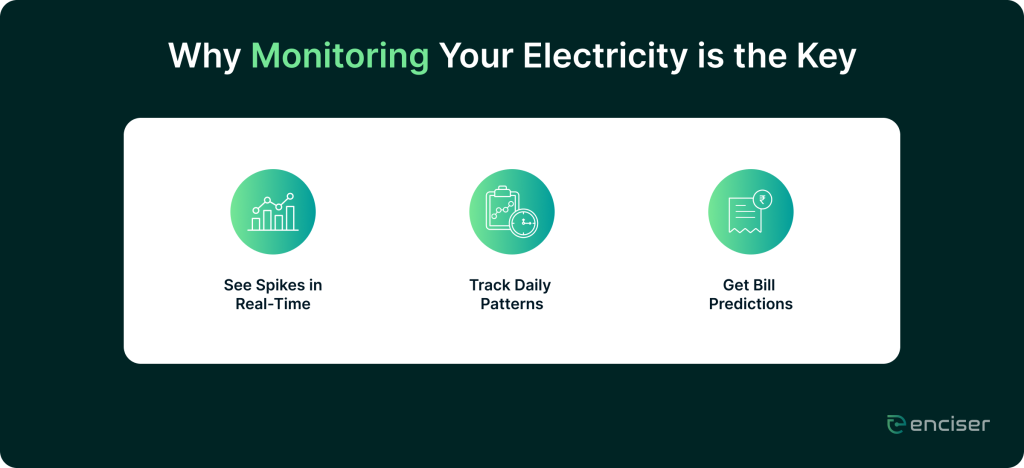
This is where enciser steps in and helps you:
-
See spikes in real-time so you know when your usage suddenly goes up.
-
Track daily patterns to understand when your household consumes the most.
-
Get bill predictions so there are no end-of-month surprises.
When you can see your usage clearly, it becomes easier to take action. For example, if you notice a spike every evening at 7 pm, you know something is causing a sudden jump. With that knowledge, you can adjust your routine to bring it down.
Real World Example: How Monitoring Boosted Solar ROI
Let’s look at how a simple habit of monitoring turned an average solar setup into a real savings machine.
A family in Gujarat had installed a 4 kW rooftop solar system. On paper, it should have cut their electricity bill by more than half. But after six months, the savings barely touched 30%. The family assumed the system was underperforming and even considered adding more panels.
Once they started using a monitoring tool like enciser’s Emerald, the real problem became clear. The system was generating enough power during the day, but most of the household’s electricity usage happened at night. Heavy appliances such as washing machines, geysers, and ACs were being run after sunset, pulling expensive units from the grid instead of using free solar power.
By simply shifting their routine, running the washing machine in the afternoon, setting the geyser to heat water before sunset, and slightly adjusting AC timings, their solar utilization jumped. Within two billing cycles, their savings grew from 30% to nearly 65%.
What changed wasn’t the solar panels themselves, but the visibility that monitoring gave. When the family could see the spikes in real time, it became easier to connect the dots and adapt their habits. In just one year, that difference meant thousands of extra rupees saved, improving their overall return on investment (ROI).
Common Mistakes that Reduce Solar Savings
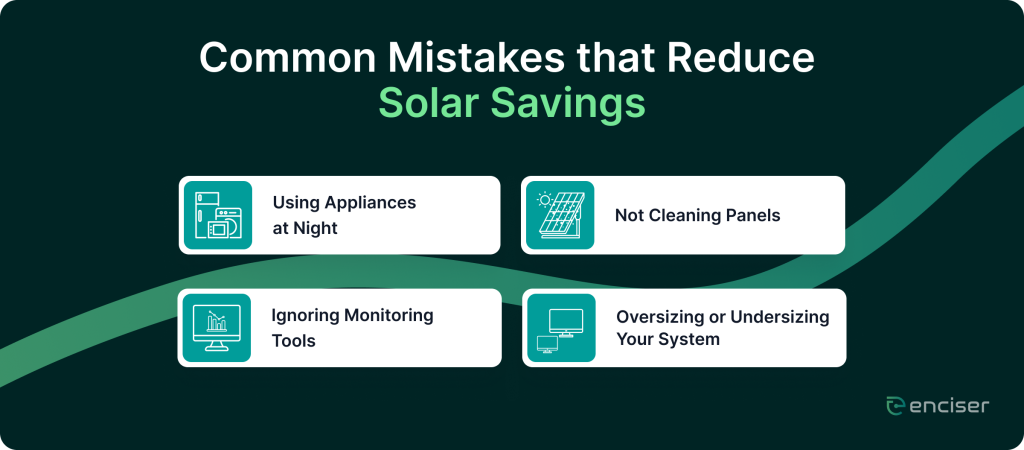
Even with solar panels, some habits can cut your savings short. Here are the most common mistakes to avoid:
-
Using heavy appliances at night without a battery: Imagine cooking a big meal when your kitchen stove has no gas. You will have to depend on another source. Similarly, without batteries, nighttime usage comes from the grid, not your solar system.
-
Not cleaning panels regularly: A thin layer of dust can reduce performance by up to 20%. It is like trying to read with dirty glasses.
-
Ignoring monitoring tools: If you don’t check your usage, you will never know where savings are slipping away. Monitoring is like a fitness tracker for your energy habits.
-
Oversizing or undersizing your system: Too small means you still pay big bills, too big means wasted investment. Think of it as buying shoes: the wrong size is uncomfortable either way.
Conclusion: Turning Solar Panels into a Long-Term Savings Machine

Solar panels save money, but real success comes when you use them smartly. Use electricity when the sun is shining, keep your panels clean, and monitor your usage closely. Small changes in habits can turn your panels into a powerful, long-term savings machine.
Remember, solar is not just about cutting bills today. It is about giving your home energy freedom for the next 20 years.
FAQs
1. Will solar panels eliminate my electricity bill?
2. Do solar panels work at night?
3. How does monitoring help me save money if it doesn’t track appliances?
4. Can enciser predict my electricity bill?
5. How long do good-quality solar panels last?

 Previous Blog