Electricity bills are a recurring part of every household or business budget, but do you know what really drives the amount you pay each month? If not, read through this blog to learn everything you need to know. Alternatively, for a simpler option, use the Tamil Nadu Electricity Bill Calculator to find out your bill amount hassle-free.
Electricity bills are a recurring part of every household or business budget—but do you know what really drives the amount you pay each month?
In Tamil Nadu, your electricity bill is shaped by more than just how much power you use. From slab-based tariffs and connection types to fixed charges and government subsidies, several factors come together to determine your final payable amount.
And now, with updated tariff structures being introduced in 2026, understanding these changes isn’t optional—it’s essential.
Whether you’re a homeowner trying to stay within the 100-unit free limit or a business owner managing high-consumption equipment, knowing how the unit rate is calculated can help you make smarter decisions and avoid unexpected spikes in your bill.
This expert-backed guide unpacks everything you need to know:
- A clear breakdown of Tamil Nadu’s slab-wise unit rates
- Key factors that determine your bill
- What’s new in the 2026 tariff revision and why it matters
- Hidden charges and components that impact your total payable amount
- Actionable tips to lower your electricity bill without major lifestyle changes
- How Enciser’s Emerald helps you track, optimize, and save in real time
If you’re ready to go from confused to confident about your electricity usage, let’s dive in.
What is the Electricity Unit Rate and How It’s Determined
The electricity unit rate refers to the cost charged per kilowatt-hour (kWh) of electricity you consume.
In Tamil Nadu, this rate isn’t just a flat fee—it’s a structured system influenced by multiple variables. Whether you’re a homeowner running everyday appliances or a business owner managing heavy equipment, understanding how this rate is calculated can help you better manage your usage and control your costs.
The rates typically vary depending on:
Consumer Category: Rates differ based on whether the user is domestic, commercial, agricultural, or industrial—each has its own tariff structure.
Monthly Consumption: The more electricity you use, the higher your per-unit rate may be under slab-based billing.
Type of Connection: Single-phase connections (for homes) are usually cheaper than three-phase ones used in businesses.
Time of Usage: Some regions charge more during peak hours and less during off-peak times to balance grid demand.
2026 Domestic Electricity Tariff Slabs in Tamil Nadu

Understanding electricity rates doesn’t have to be confusing. Let’s walk through the latest slabs for 2026, broken down in a way that’s easy to follow.
➤ For Low Consumption Households (0–200 units)
- Unit Rate: ₹4.95 /kWh (First 100 units, bi-monthly, may be free under the subsidized scheme.)
This slab continues to offer relief for low-usage households. It’s ideal for small families or rural homes with limited appliances.
➤ For Moderate Use (201–250 units)
- Unit Rate: ₹6.65/kWh
This is where many urban households fall. If you’re slightly over the 100-unit mark, it’s worth monitoring closely to avoid crossing into higher slabs.
➤ High Usage (251–300 units)
- Unit Rate: ₹8.80/kWh
Costs rise steeply here. Regular monitoring can help you optimize your usage and stay under thresholds.
➤ For Usage (301-400 units)
- Unit Rate: ₹9.95/kWh
This slab hits large households with multiple ACs, geysers, and continuous appliance use. High energy users have the most to gain from active monitoring tools.
➤ For Usage (401-500 units)
- Unit Rate: ₹11.05/kWh
Bills rise sharply here. Tracking and managing appliance use becomes essential to avoid further hikes.
➤ Usage above 500 units
- Unit Rate: ₹12.15/kWh and above
This is the costliest slab. Smart usage and energy-efficient choices can help reduce the impact.
Let’s Break It Down with an Example
Let’s say your household consumes 470 units in a single month.
Here’s how your electricity bill would be calculated under the July 2026 domestic tariff:
- First 200 units (0–200): 200 × ₹4.95 = ₹990.00
- Next 50 units (201–250): 50 × ₹6.65 = ₹332.50
- Next 50 units (251–300): 50 × ₹8.80 = ₹440.00
- Next 100 units (301–400): 100 × ₹9.95 = ₹995.00
- Final 70 units (401–470): 70 × ₹11.05 = ₹773.50
Total Energy Charges: ₹3,531.00
Fixed Charges: ₹0 (Domestic consumers are exempt)
Total Monthly Bill: ₹3,531.00 + GST/surcharge
A small reduction in usage can bring you back into a lower slab, saving hundreds every month.
Confused by your electricity bill?
Use our bill calculator to get a clear picture in seconds.
Commercial and Industrial Tariffs
For small businesses, shops, or offices, the rates differ significantly:
➤ HT Industries, Factories, IT services
Unit Rate: ₹7.25/kWh
Demand Charges: ₹589/kVA/month
➤ HT Commercial and Misc. categories
Unit Rate: ₹9.10/kWh
Demand Charges: ₹589/kVA/month
➤ LT Industries and IT services
For 0-50 kW Usage: ₹8.00/unit and Fixed Charges of ₹81.00/kW/ month
From 50-112 kW: ₹8.00/unit and Fixed Charges of ₹160/kW/ month
Above 112 kW: ₹8.00/unit and Fixed Charges of ₹589/kW/ month
Commercial users should closely track both consumption and load factor to avoid penalties and overcharges.
Other Components of Your Electricity Bill
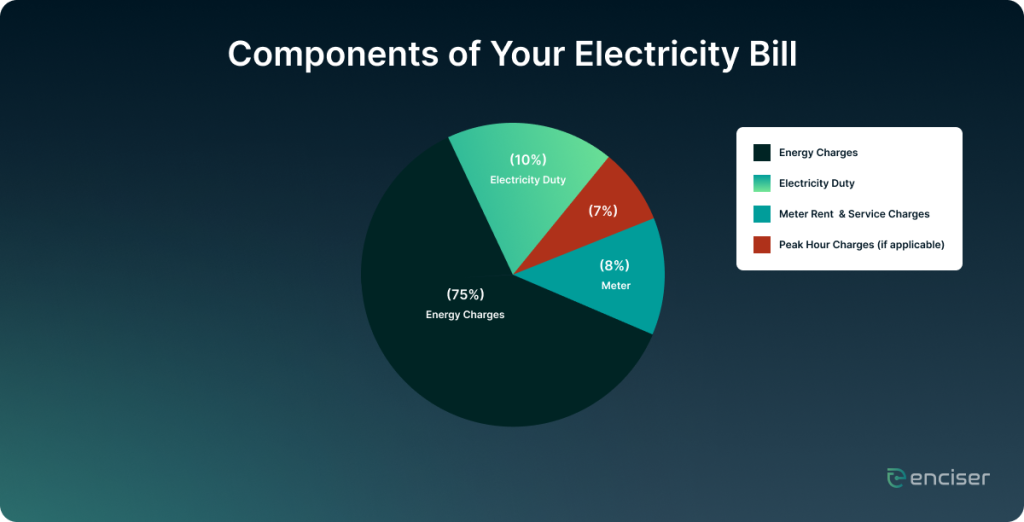
While the unit rate forms the base of your bill, it’s not the only charge you’re paying. Several additional components can significantly affect your total payable amount:
- Fixed Charges: A standard monthly fee based on your connection type or sanctioned load. However, domestic households are exempt from paying fixed charges.
- Electricity Duty: A state-imposed tax, usually calculated as a percentage of your energy charges.
- Meter Rent & Service Charges: Minimal fees for metering equipment and maintenance services.
- Peak Hour Charges (if applicable): In some regions, usage during peak hours may be billed at a higher rate.
Understanding these components helps you see the full picture—not just how much energy you use, but how the system prices it.
How Are These Rates Decided?
Have you ever questioned what goes into determining the cost of each electricity unit in Tamil Nadu? It’s not arbitrary—and it’s about more than just your consumption.
Here’s a clear breakdown of the process:
1. TANGEDCO (Tamil Nadu Generation and Distribution Corporation) prepares a detailed tariff proposal. This includes estimated costs for:
- Purchasing electricity from power producers
- Maintaining and upgrading infrastructure (like transformers and grids)
- Daily operational expenses
- Meeting renewable energy targets set by the state
2. This proposal is submitted to TNERC (Tamil Nadu Electricity Regulatory Commission), the authority responsible for evaluating and approving electricity tariffs. TNERC reviews the data, assesses the justifications, and makes necessary adjustments before finalizing the rates.
3. Once approved, these rates are implemented across the state. Tariffs are typically revised annually or biennially, depending on economic conditions and infrastructure needs.
Why the rate change in 2026?
The increase was mainly driven by a rise in input fuel costs and investments in infrastructure upgrades—factors that impacted the higher consumption slabs the most.
Smart Tips to Reduce Your Monthly Electricity Bill
Even if rates go up, your bill doesn’t have to. Try these:
1. Switch to LED lights and energy-efficient appliances
→ Even a simple switch can reduce your usage by 15–20%.
2. Unplug idle electronics
→ Standby power loss adds up, especially in high-consumption homes.
3. Use timers for geysers and air conditioners
→ Optimize runtime without manual checks.
4. Track daily usage with smart tools
→ Real-time monitoring creates better awareness and habits.
5. Plan appliance use outside peak hours (if possible)
→ Especially useful for time-sensitive tariff plans.
Tired of high bills with no explanation? Let Electricity Usage Monitor—Enciser’s Emerald, show you where the power goes—and where to save.
Why Real-Time Monitoring Matters (And How Emerald by Enciser Helps)
Looking at your electricity bill once a month? That’s like checking your weight once a year and hoping for the best.
If you really want to control your power usage—you need to see it live. This is where smart technology like Enciser’s Emerald changes the game.
With Emerald, you can:
- Track your live power consumption—see exactly how much you’re using right now, not weeks later.
- Spot energy guzzlers—identify which appliances are quietly hiking your bill.
- Get instant alerts—for unusual usage spikes or system abnormalities.
- Break down your usage—day-wise, hour-wise, even device-wise insights.
Whether you’re a homeowner trying to stay under 200 units or a store owner managing heavy equipment, real-time visibility can translate into thousands saved every year.
Bonus: Emerald plays well with others—integrate it seamlessly with your solar panels, battery backups, or EV charging stations for smarter, greener energy management.
Final Thoughts: Know Your Power, Control Your Costs
Electricity rates will keep changing—but your control over your consumption doesn’t have to. Whether you’re navigating Tamil Nadu’s slab-based system or simply trying to stay on budget, staying informed is half the battle.
And the other half? Visibility. When you can see where your power is going, you can finally do something about it.
So keep an eye on your usage, stay slab-aware, and if you’re ready to take full control, consider tools like Emerald by Enciser to turn your home into a smarter, more energy-conscious space.
FAQs
1. How is the electricity tariff determined in Tamil Nadu?
2. Can I manually switch between tariff slabs to reduce my bill?
3. Is the 100-unit free electricity scheme still in effect for domestic consumers?
4. What is the difference between single-phase and three-phase connections?

 Previous Blog