Voltage stabilizers are commonly used in Indian homes and offices, especially in areas where the power supply is unstable. Yet, many people hesitate to use them because of one persistent doubt: What if a voltage stabilizer increases your electricity bill?
This question is valid because when you add any new electrical device, it feels logical to assume that your power usage will go up.
However, the reality is far more balanced and practical than most people expect. A voltage stabilizer does consume electricity, but how much it consumes, when it matters, and whether it truly impacts your bill depends on how it is used, where it is used, and what appliances it supports.
This blog clarifies how voltage stabilizers actually affect your electricity costs. You will learn how they work, how much power they use, when they may raise or reduce your bill, and how to use them wisely so appliance protection does not come with unnecessary expense.
Why People Think a Voltage Stabilizer Increases the Bill
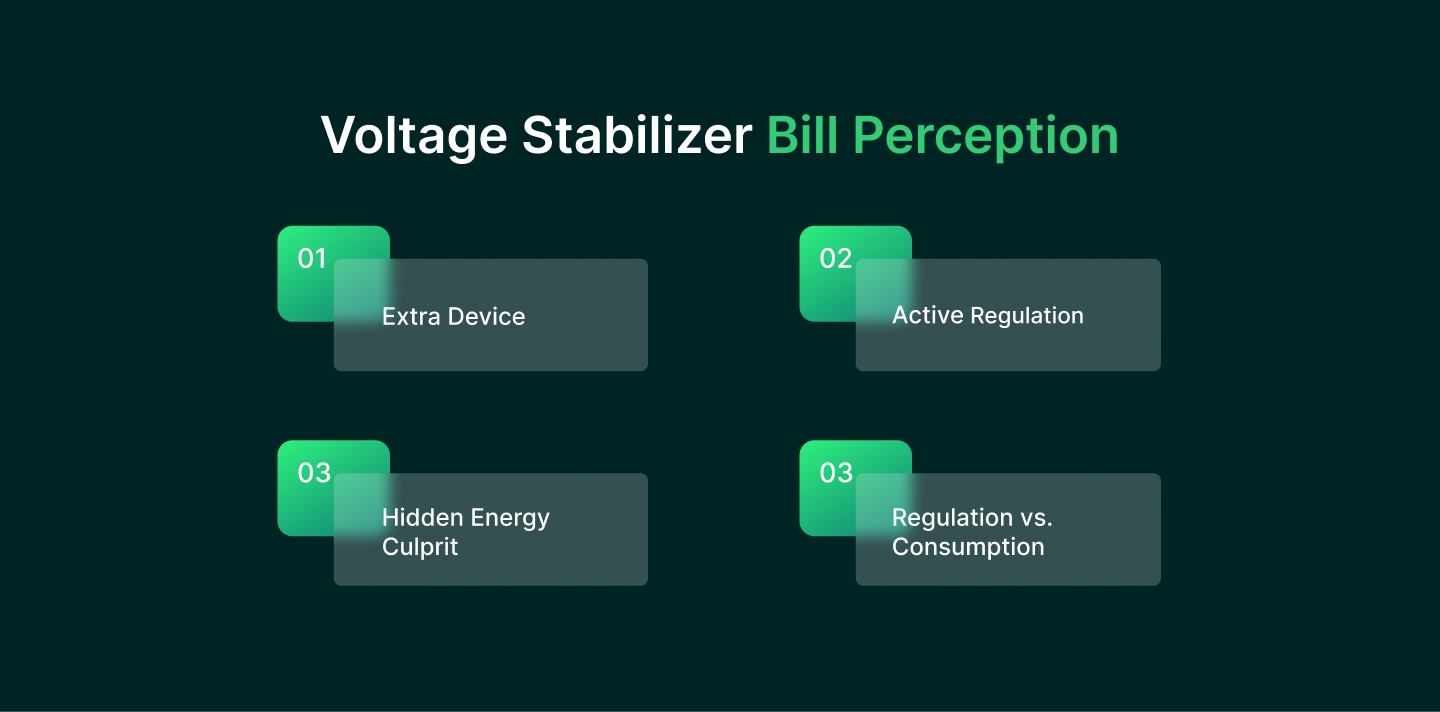
Many people assume a voltage stabilizer increases the electricity bill, and this belief usually comes from a few observations.
- People often see a stabilizer as an extra device added to the circuit. Since it sits between the power supply and the appliance, it feels like one more machine that is always running and consuming electricity.
- Stabilizers become more noticeable during voltage fluctuations. When lights flicker or appliances struggle, the stabilizer starts regulating power, which makes it appear active and energy-intensive, even though its actual power usage is very small.
- Electricity bills show only the total units consumed, not the usage of individual devices. When the bill rises, people naturally look for recently added equipment, and the stabilizer becomes an easy suspect.
- There is also confusion between regulation and consumption. Many people assume that because a stabilizer is “working,” it must be using significant power.
In reality, a stabilizer is designed to protect and regulate, not to consume electricity for output or comfort. Understanding this difference helps separate assumption from actual impact on your bill.
How a Voltage Stabilizer Works and How Much Power It Uses
To understand whether a voltage stabilizer increases your electricity bill, it is important to first understand what it actually does inside your electrical system.
A voltage stabilizer continuously monitors the incoming power supply. When the voltage becomes too high or too low, it automatically adjusts the output to a safe and stable level before the electricity reaches your appliance. This protects devices like air conditioners, refrigerators, televisions, and washing machines from damage caused by voltage fluctuations and uneven power supply.
Yes, a voltage stabilizer does consume electricity, but the nature of its consumption is very different from that of regular appliances. It does not run motors, produce heat, or perform heavy mechanical work. It mainly powers internal components such as transformers, sensors, control circuits, and relays, which require very little energy to operate.
The stabilizer uses electricity in two simple ways:
- When it remains on standby, quietly monitoring voltage levels
- When it actively corrects voltage fluctuations and stabilizes the output
In both situations, the power drawn is minimal compared to the appliances it protects.
How Much Power Does a Voltage Stabilizer Use in Real Life
Most household stabilizers consume between 2 and 15 watts, depending on their size and capacity. Even stabilizers designed for air conditioners or larger systems usually use far less power than the appliances they support.
To put this into perspective:
- A typical air conditioner uses around 1500 to 2500 watts
- A refrigerator uses about 150 to 300 watts
- A stabilizer usually uses less than 1 percent of that
So when people ask whether a stabilizer consumes electricity, the honest answer is yes, but the amount is so small that it rarely makes a noticeable difference to your electricity bill by itself.
If a stabilizer is properly selected and maintained, its impact on total electricity consumption remains almost negligible while offering valuable protection to your appliances.
When a Stabilizer Reduces Your Bill (and When It Doesn’t)
This is where the stabilizer’s role becomes truly practical, and where most confusion around electricity bills usually starts.
A voltage stabilizer can actually help control your electricity costs indirectly, even though it uses a small amount of power itself. When voltage fluctuates, appliances are forced to operate under stress. Motors heat up, compressors work harder, and devices lose efficiency. Over time, this leads to higher electricity usage and faster wear of equipment.
A stabilizer prevents this by ensuring appliances always receive power within a safe and stable range, which keeps energy usage smooth and avoids unnecessary power draw.
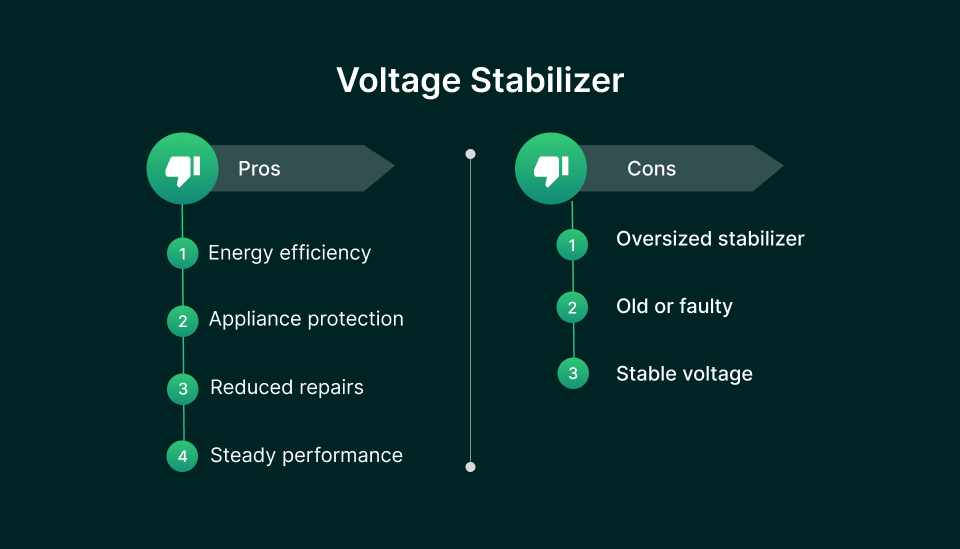
A stabilizer helps your electricity bill when:
- It protects appliances from voltage fluctuations that make them consume extra power
- It keeps motors and compressors working efficiently instead of under stress
- It reduces repeated breakdowns that increase repair and replacement costs
- It supports steady performance without hidden energy waste
However, a stabilizer can also become unnecessary consumption in certain cases:
- When an oversized stabilizer is used for a small appliance
- When the stabilizer is old, faulty, or poorly maintained
- When it is installed in places where the voltage is already stable
In these situations, the stabilizer does not add real value, and its small power usage becomes avoidable.
This is why the stabilizer’s impact on your electricity bill depends more on how and where it is used than on the device itself. Regularly monitoring your electricity usage with tools like enciser’s Emerald helps you understand whether the stabilizer is actually improving efficiency or simply adding another load, allowing you to make smarter and more cost-effective energy decisions.
How to Use a Voltage Stabilizer the Right Way
Using a voltage stabilizer correctly ensures that your appliances remain protected without unnecessarily increasing electricity consumption. Small and practical adjustments can make a noticeable difference to both energy use and appliance lifespan.
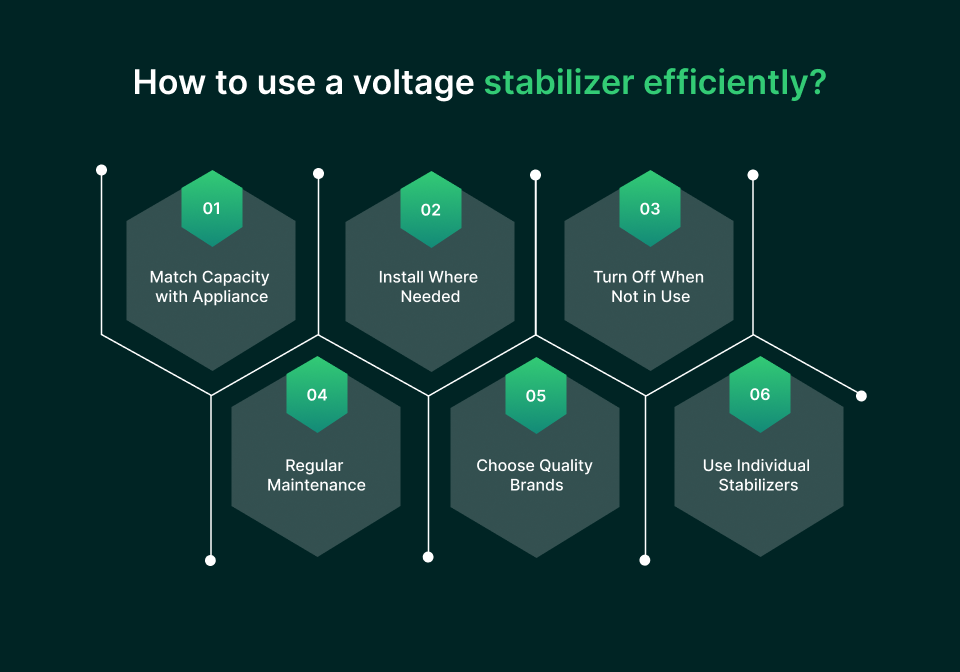
Tips for smart usage:
- Match the stabilizer with appliance capacity: Use a stabilizer that suits the specific appliance. Avoid high-capacity stabilizers for smaller devices, as they draw slightly more standby power.
- Install only where needed: Do not use a stabilizer in areas with stable voltage unless the appliance is extremely sensitive.
- Turn off when not in use: Switch off the stabilizer if the connected appliance will remain unused for long periods, such as overnight or during vacations.
- Regular maintenance: Periodically check and maintain the stabilizer so that internal components like transformers, relays, and circuits operate efficiently.
- Choose quality brands: Avoid cheap or unbranded stabilizers that may waste power due to poor design or inefficiency.
- Use individual stabilizers for sensitive devices: Instead of one large stabilizer for multiple appliances, use separate units unless professional guidance advises otherwise.
Following these steps ensures that your stabilizer protects your appliances effectively while keeping electricity consumption minimal, helping you save on bills without compromising safety or performance.
How enciser’s Emerald Helps You Use Stabilizers More Smartly
One of the biggest challenges with electricity consumption is that people rarely see where their power is actually going. This is where enciser’s Emerald becomes extremely valuable.
enciser Emerald helps you monitor total electricity usage in real time and track changes when appliances or devices are added or removed. Instead of guessing whether a stabilizer is affecting your bill, you can actually observe patterns and make informed decisions.
For example, if you install a stabilizer for your AC, Emerald helps you:
- See whether your total power usage stabilizes
- Identify abnormal consumption patterns
- Verify if appliance efficiency improves over time
This shifts electricity management from assumptions to clarity. It allows you to protect appliances without worrying about hidden power costs.
Common Myths About Voltage Stabilizers and Electricity Use
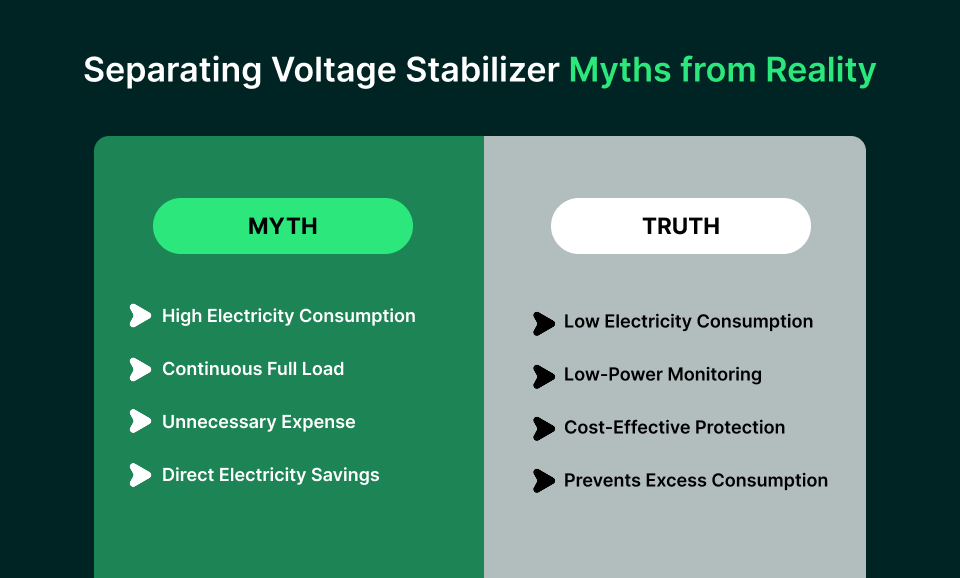
Many misunderstandings about voltage stabilizers exist because people rely on assumptions rather than facts. Let’s separate myth from reality.
- Myth: Stabilizers consume as much electricity as the appliances they support
Truth: Stabilizers use only a small fraction of the power that the appliances draw, making their impact on bills minimal.
- Myth: Stabilizers run continuously at full load.
Truth: They operate mainly in low-power monitoring mode and activate only when voltage fluctuates.
- Myth: Stabilizers are unnecessary expenses.
Truth: In areas with frequent voltage fluctuations, they protect appliances from damage, preventing costly repairs that far exceed their small electricity usage.
- Myth: Stabilizers directly save electricity.
Truth: They do not reduce units on their own but prevent excess consumption caused by inefficient appliance operation.
Understanding these facts ensures you use stabilizers wisely without overestimating their electricity impact.
Do You Need a Voltage Stabilizer for Your Appliances?
Whether a voltage stabilizer is necessary depends on the stability of your power supply and the type of appliances you use. You are more likely to need one if your lights flicker often, appliances trip or restart, you live in areas with inconsistent supply, or you use sensitive devices like ACs, refrigerators, servers, or medical equipment.
In locations with stable voltage and modern infrastructure, a stabilizer may not be essential for all appliances. The key is to use stabilizers selectively, prioritizing protection for devices that are most vulnerable, ensuring safety without unnecessary electricity usage.
Final Verdict on Voltage Stabilizers and Electricity Bills
So, does a voltage stabilizer increase your electricity bill?
The clear and honest answer is: a voltage stabilizer consumes a small amount of electricity, but it does not significantly increase your bill when used correctly.
In most cases, the power usage of a stabilizer is so low that it is barely noticeable in your total consumption. At the same time, the protection it offers helps appliances operate efficiently and prevents costly damage.
The stabilizer becomes a problem only when it is oversized, unnecessary, faulty, or poorly maintained.
When selected wisely and used appropriately, a voltage stabilizer is not an expense that raises your bill. It is a tool that protects your appliances, supports efficient operation, and gives you peace of mind.
And when combined with visibility tools like enciser Emerald, you gain full control over how electricity is being used, making your decisions smarter and more confident.
FAQs
Does a voltage stabilizer increase the electricity bill in India?
Is it better to use a stabilizer for the AC and the refrigerator?
Can a voltage stabilizer help reduce electricity consumption?
Is a stabilizer necessary if the voltage is stable in my area?
Does a faulty stabilizer consume more electricity?
How can I manage stabilizer usage more efficiently?

 Previous Blog
