Electricity makes our homes and small shops run. Lights, fans, AC, fridge, phone chargers, all of it. When we use more than we need, our bill goes up, and the local grid gets stressed.
The good part is this. Saving electricity is practical and easy to start. See what is happening, make a few small changes, and plan your month so there are no surprises.
This guide shows simple steps you can use today. If you want help, a real-time monitor like enciser can show total use and send gentle alerts. The focus here is on action you can take now.
What You Gain by Saving Electricity
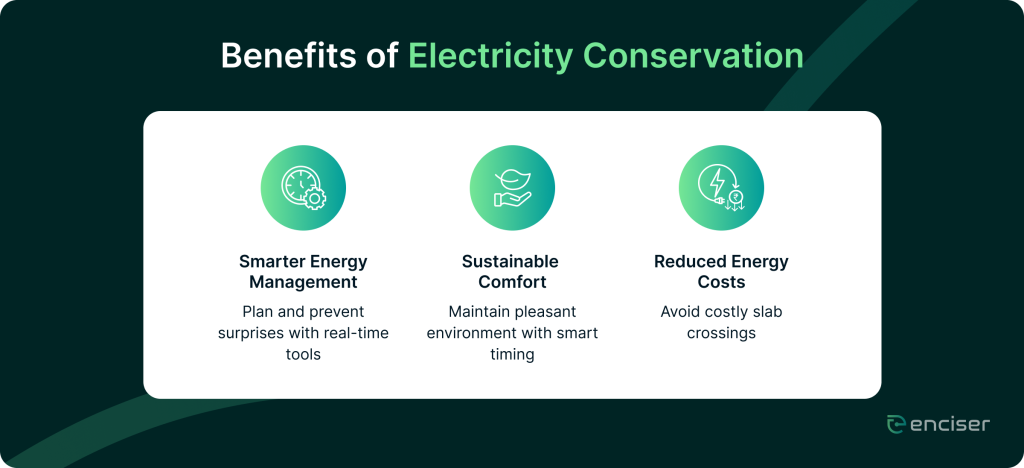
When you understand how and when you use electricity, you can protect your wallet, stay comfortable, and avoid surprises. Small changes in timing and settings go a long way.
Here is how it helps you.
Lower bills
A few extra units can cost more than you think because many bills use slabs. Crossing a slab makes each extra unit pricier. The goal is simple: stay in the right slab by avoiding waste and spikes.
-
Many places use slab billing. If you cross a unit limit, the price per unit gets higher.
-
A few extra units from small spikes can push you into the next slab.
-
By watching your use and fixing small waste, you can avoid slab jumps.
Comfort stays the same
Saving electricity is not about sacrifice. It is about smart timing and healthy appliances. When machines are not overworked, rooms stay cool, quiet, and pleasant.
-
Saving power is not about suffering. It is about timing and smart settings.
-
When appliances run well, your rooms stay cool and quiet without extra load.
More control month to month
Seeing the numbers brings calm. You can spot patterns, plan your month, and prevent surprises before they happen. Real-time tools make this easy.
-
When you track daily and weekly use, you see patterns.
-
You know what to change and what to keep.
-
A tool like enciser can show live use and give gentle alerts, so you do not need to guess.
Quick example: Running the washing machine at 7 pm while the AC is on causes a spike. Moving laundry to the morning keeps comfort and cuts the spike.
How Smarter Energy Use Supports Your Community

Electricity is a shared system. What you do at home affects your street, your building, and your city. When many homes use a lot of power at the same time, the whole network feels it.
Stronger, safer grid: Evenings are the busiest hours. If many homes run heavy devices together, local lines and transformers heat up and slow down. This can lead to voltage dips and outages. When we spread out our heavy use, the peak becomes smaller and the grid stays healthy.
Cleaner air and lower water use: Power plants need fuel and water to make electricity. Using a little less at home reduces both. One unit saved in your flat is one unit the plant does not need to produce. Small cuts across many homes make a clear difference.
Fair, steady costs for everyone: Peak power is the most costly part of the system. If we reduce peaks, the network needs fewer emergency fixes and fewer fast, expensive power buys. Over time, that helps keep bills more stable for all.
Major Reasons Why Your Energy Bill Keeps Rising
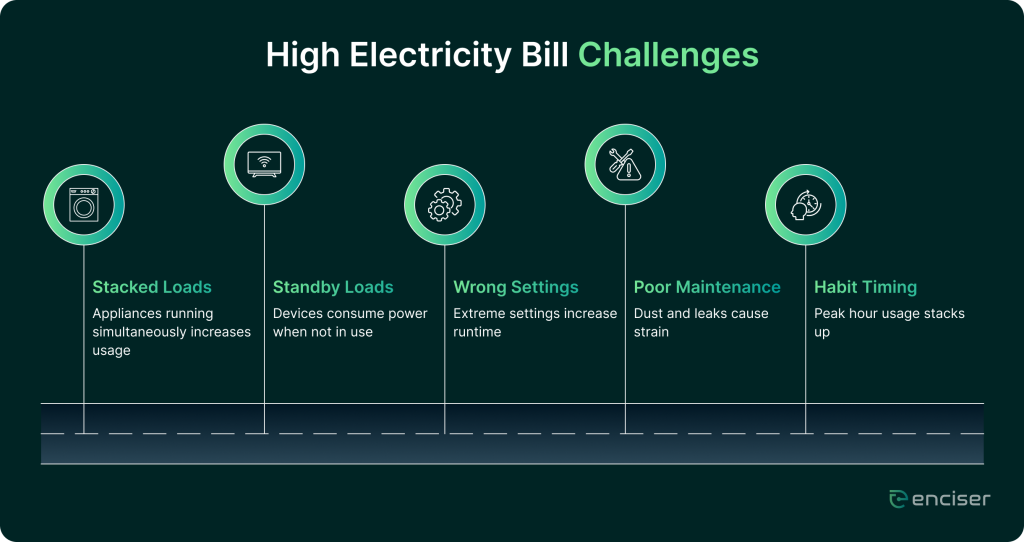
You do not need new appliances to lower your bill. Start by fixing these common causes that quietly raise usage.
Stacked loads
Running two heavy appliances at the same time makes your usage jump in that hour. A common example is the AC running while the oven or geyser is on. The AC has to fight the extra heat, so it runs harder and longer, and that spike can push you closer to the next slab. The easy habit is to stagger these tasks. Finish the geyser or oven cycle first, then use the AC normally.
Standby loads
Many devices keep sipping power even when they look “off.” TV units, set-top boxes, game consoles, speakers, routers, and chargers left plugged in draw small amounts all night. Each one is tiny, but together they add up over weeks. Making a habit of switching off the power strip at the end of the day stops this slow, silent waste.
Wrong settings
Very low AC temperatures and long geyser runs cost more than most people expect. The lower you set the AC, the longer the compressor runs to chase that number. The same is true for a geyser left on far past the time you need hot water. Small changes help: set the AC one or two degrees higher, use a timer for the geyser, and keep the fridge on a mid setting. You keep the comfort the same while cutting extra runtime.
Poor maintenance
Dust and leaks make appliances work harder. A clogged AC filter blocks airflow, so cooling takes longer. Dusty fridge coils and loose door seals force the motor to cycle more often. A simple routine helps: clean AC filters monthly, vacuum fridge coils every few months, and check door seals. Each machine will do the same job with less electricity.
Habit timing
Evenings are peak hours in most homes. If laundry, ironing, cooking with the oven, and AC all happen between 6–9 pm, your usage stacks up day after day. Shifting just one heavy task to morning or later at night flattens those peaks. Over a month, this small shift can be the difference between staying in your slab or crossing it.
Follow The Simple Model: Find, Fix, Forecast

Find: Spot the Patterns That Drive Your Bill
The first step is awareness. You cannot cut your electricity bill unless you know when and how you are using the most power.
Start by simply observing. See your live usage and watch how it changes throughout the day. For one week, keep what we call a “spike diary.” Each time you notice the numbers jump, write down the time, what was running, and what you could do differently next time. Maybe you turned on the washing machine while the AC was already on. Maybe the microwave and the water heater overlapped. Writing it down helps connect cause and effect.
You do not need to track every single plug. A monitor like enciser Emerald shows your entire home’s usage in real time. That is enough to reveal the big patterns, such as when your evenings are consistently heavier or how weekends differ from weekdays.
Fix: Make Small Adjustments That Save Big
Once you know the patterns, small fixes make a big difference.
-
Do not overload your meter. Avoid running two heavy devices (like an AC and a washing machine) at the same time. Stagger them if possible.
-
Switch off completely. Use a master switch or power strip for your TV corner, chargers, or other electronics. At night, turn them off. Even standby mode quietly consumes power.
-
Tweak your AC. A small change, such as setting it to 25°C instead of 22°C, saves units without reducing comfort.
-
Keep appliances healthy. A clogged AC filter forces the machine to work harder. A loose fridge seal leaks cool air. Do a simple paper-strip test: close the door on a piece of paper, and if it slides out easily, the seal needs repair.
These are easy adjustments that help you cut waste while keeping the same comfort.
Forecast: Stay Ahead and Avoid Bill Shock
Now comes the proactive part, planning ahead instead of waiting for the bill shock.
-
Set a monthly target. Decide how many units you want to stay under.
-
Check weekly. Open your app once a week and compare where you stand. Are you on track, or running higher than usual?
-
Adjust early. If the trend shows you may cross into a higher slab where every extra unit costs more, make a small change that same month. Use fans more often, delay laundry loads, or reduce AC time slightly.
This way, you are not reacting after the bill arrives. You are steering your usage in real time.
Here’s how Enciser helps you stay in control
enciser Emerald focuses on whole-home usage, not individual appliances. But that is actually an advantage. You do not need dozens of plug monitors. One glance shows you if the home is spiking, and from there, your spike diary and awareness of routines help you know what to adjust. No guesswork, just clear and actionable insights.
By following Find, Fix, Forecast, you move from confusion about your bill to real control. And the best part is that these steps are simple enough for anyone to start today.
Everyday Tips to Lower Your Energy Consumption
Saving energy is easier than it seems. Start with small actions you can do right now, add quick low-cost fixes, and plan smart upgrades for later. Each step brings you closer to lower bills and a more efficient home.
Do Now (No cost, big impact)
-
Do not run the AC with the oven or geyser at the same time.
-
Shift laundry/ironing to morning or late evening.
-
Turn off the plug strip for TV, set-top box, speakers, and chargers before bed.
-
Close doors and windows when the AC is on.
-
Tiny test tonight: Switch off the TV corner at the plug. Check your morning baseline tomorrow. You will likely see a small drop.
Do Next (Low cost, quick payback)
-
Clean the AC filters and the back coils of the fridge.
-
Add weather-stripping to doors and windows to stop leaks.
-
Use thicker curtains to block heat from sunlight.
-
Add smart power strips for media corners to cut standby use.
-
If you use enciser, set two alerts:
-
Daily cap (keep use within your plan)
-
Unusual night use (catch hidden drains)
-
Do Later (When replacing, one-time upgrade)
-
Replace old bulbs with LEDs.
-
When it is time to replace an AC or fridge, choose inverter models.
Tip: Upgrade when the old item is near the end of its life. Measure before and after so you can see the real effect. If you use enciser, check the weekly graph; if not, note meter readings at the start and end of the week.
Real-Life Case Studies
Case Study 1
A couple living in a one-bedroom apartment and working standard hours. For one week, they watched their daily pattern in enciser. The graph showed two clear issues. Their biggest bars were between 7 pm and 9 pm on laundry days, and their night baseline was never low because the TV corner stayed on standby.
They made two simple changes. Laundry moved to Saturday morning. The TV, set-top box, speakers, and game console went on one power strip that they switch off before bed. They also set a daily cap alert so they would know if a day was running hot.
Result after a month. Their evenings were flatter, the night baseline dropped, and they stayed under the slab line. The best part was the calm. No guessing, just a steady routine.
Case Study 2
In another instance, a family of four uses two rooms for work and study on weekdays. enciser showed tall bars most evenings, especially on days when the oven and the living room AC ran together. The AC worked harder against the oven heat, and the peak jumped.
They set one house rule. No oven while the AC is on in the evening. They cleaned AC filters on the first Sunday of each month and kept doors and windows closed during cooling. They turned on a sudden spike alert to catch any unexpected jump.
Result after six weeks. Evening peaks were smaller and easier to manage. The monthly forecast in the app stayed within its target, and there were fewer surprise alerts.
Myths vs Facts
When it comes to saving electricity, a lot of advice sounds convincing but does not always match reality. Some habits that feel harmless quietly add to your bill, while others that seem small can make a big difference. Let’s clear the air with a few common myths and the real facts behind them.
Myth: Standby power does not matter
Fact: Many small sips add up to a large glass.
Devices like TV units, set-top boxes, game consoles, speakers, routers, and phone chargers use a little power even when they are off. Think of a dripping tap that fills a bucket overnight. For example, three small devices using about 5 watts each for 10 hours can use roughly 0.15 units in one night. Over a month, that becomes several units you paid for without any benefit.
Myth: A higher star rating fixes everything
Fact: Right size and right use matter a lot.
A 5-star appliance still wastes power if it is used in the wrong way. A big AC set to a very low temperature, doors left open, or a fridge packed and set too cold will still draw more electricity. It is like a fuel-efficient car in stop-and-go traffic with hard braking. The label helps, but daily habits and the right size for your space matter just as much.
Myth: Saver mode means no cleaning needed
Fact: Dusty filters force the machine to work harder.
Dust blocks airflow in ACs and fridges, so compressors run longer to do the same job. Loose fridge door seals also let cold air leak out. It is like trying to breathe through a clogged mask. A quick monthly clean of AC filters, a coil vacuum for the fridge, and a check of door seals lets the same appliance give the same comfort with less power.
Helpful note: A real-time monitor like enciser makes these facts visible. You can see nighttime standby use, spikes when two heavy devices run together, and the drop in daily units after a filter clean.
Conclusion
Saving electricity is not about giving up comfort. It is about becoming aware of your daily patterns, fixing small leaks, and planning smartly so you stay in control. The best part is that anyone can start today with no big investments or complicated steps.
With a real-time monitor like enciser Emerald, you do not need to guess what is happening. You can see your whole-home usage in real time, spot spikes as they occur, and set alerts that guide you to better habits. Over time, this gives you peace of mind with lower bills, steady comfort, and the satisfaction of helping both your household and your community.
Start small, stay consistent, and let enciser show you the difference.
FAQs
1. How soon can I see results from saving electricity?
2. Why does my bill still go up even when I save?
3. How soon can I see results from saving electricity?
4. Why does my bill still go up even when I save?
5. Can renters use enciser?
6. How does enciser actually help me save?

 Previous Blog