
India’s cumulative solar capacity reached 116 GW by June 2025, including 18.8 GW of rooftop installations. This clearly shows how solar panels are becoming increasingly popular among households. And why not? They offer long-term savings, greater energy independence, and a cleaner, more sustainable source of power.
But if you think installing solar panels means you’ll keep saving on electricity bills for life with no effort, you’re mistaken. Like any other system, solar can lose efficiency over time if it’s not properly maintained, leading to lower performance and reduced savings.
So, if you have installed solar panels on your rooftop and want to reduce your bills, the next big question is: How do you know you’re actually saving?
Do you wait a whole month for the bill, only to be left wondering why it’s still higher than expected?
Have you ever thought about how much electricity your home uses at different times of the day?
Do you know whether your consumption habits are helping you get the most from your solar setup or quietly eating into your savings?
Wouldn’t it be easier if you could see your electricity use in real time, down to the minute?
You’ll get the answers to all your questions down below. Simply follow the blog information, and you’ll find the answer to each question down below.
What Does Solar Efficiency Actually Mean?
Solar efficiency is the ability of your solar panels to convert solar energy into electricity. The more efficient your solar panels are, the more electricity they generate, converting sunlight into actual consumable energy.
Say, for instance, solar panels are delivering an efficiency of 20%. It means they are able to generate 20% electricity out of the total sunlight falling on them. The better the efficiency, the better the results will be in terms of the electricity generated.
If we talk about the efficiency range of solar panels:
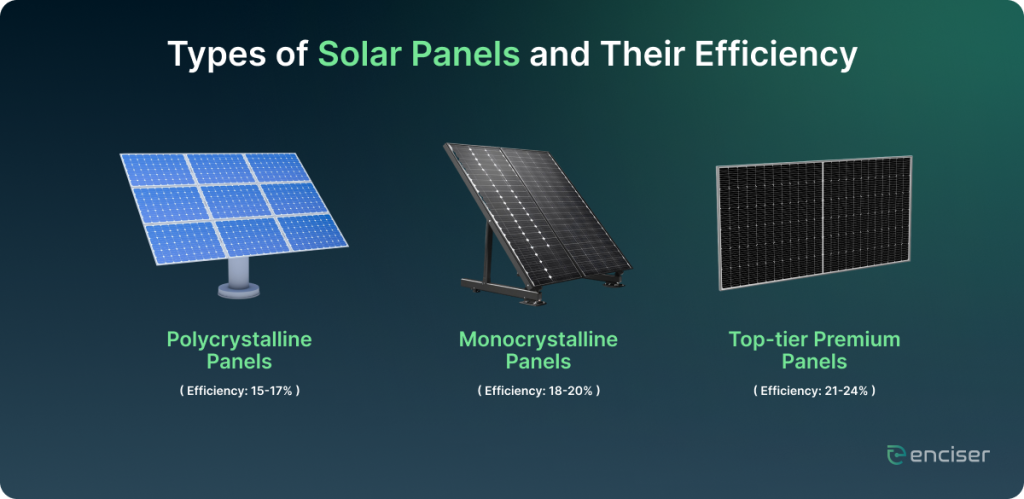
Polycrystalline panels typically deliver 15–17% efficiency. Also called multicrystalline panels, they are made by melting raw silicon and pouring it into moulds to achieve square-shaped wafers. They have a bluish appearance with a fragmented crystal pattern. They offer lower efficiency compared to others, which means you need more panels to generate the same power.
Monocrystalline panels are made with a single, pure silicon crystal sliced into wafers. They have a uniform black appearance with rounded edges. They deliver higher efficiency and save space since fewer panels are needed for the same output. Such panels are recommended for homes with limited roof space and those seeking long-term performance.
Top-tier premium panels are advanced versions of monocrystalline panels, often using cutting-edge technologies such as N-type cells or IBC (Interdigitated Back Contact) cells. They come in a sleek, often all-black appearance with minimal visible wiring. These panels are more expensive compared to other options and serve high-end users, tech-savvy buyers, or anyone focused on maximum energy generation from minimal space.
Despite choosing efficient solar panels, there are still many factors at play that affect their performance and overall energy output.
Common Factors That Impact Solar Efficiency
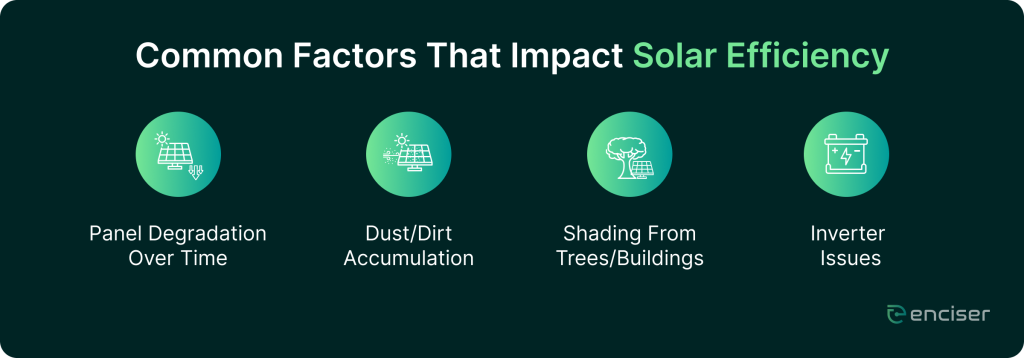
- Panel degradation over time – Solar panels naturally lose efficiency each year, typically around 0.5 percent annually, leading to reduced energy output over time.
- Dust/dirt accumulation – A layer of dust, bird droppings, or pollution can block sunlight and significantly lower the amount of energy your panels generate.
- Shading from trees/buildings – Even partial shade on a panel can disrupt the flow of electricity across the system and reduce its overall performance.
- Inverter issues – If the inverter, which converts solar energy into usable electricity, malfunctions or gets old, it can cause power loss or interruptions in energy conversion.
Signs Your Solar Panels Might Not Be Performing Well
- Unexpected spike in bills – A sudden rise in your electricity bill is a clear sign that your solar panels may not be functioning at their best and likely need inspection or repair to restore optimal performance.
- High grid dependency during the day – If you notice you’re relying heavily on the grid during the day and your energy needs aren’t being met by solar generation, it’s a strong sign your panels may not be performing well.
- Low export readings – If your net meter shows lower-than-expected export levels, your panels may be underperforming, or your in-house energy consumption might be unusually high.
- Inverter error alerts – Warning lights, error codes, or unusual sounds from your inverter can indicate technical issues that are affecting your panels’ performance.
- Mismatched output – A significant difference between expected and actual solar output can indicate inefficiencies that are limiting your system’s performance.
Why Relying on Electricity Bills Isn’t Enough

You got the panels installed on your rooftop, and now you are all geared up to receive the reduced bill amount. And then comes the moment of truth, a bill much higher than you were expecting, leaving you wondering how it still came out higher than expected. You thought you were doing everything right, so why does it feel like something’s missing?
Here’s what most solar users don’t realize: the bill alone doesn’t tell the whole story.
1. No Visibility into Solar Performance
Solely relying on your electricity bills to know if you are making significant savings from your solar isn’t enough. You won’t get a detailed picture of your electricity consumption:
- How much energy did your solar panels actually generate
- Whether your system underperformed due to weather, dirt, or hardware issues
- If your inverter is functioning optimally
- How much of your daytime consumption was covered by solar vs. pulled from the grid
2. Delay in Problem Detection
If any problem is persisting within the solar setup, such as a faulty panel, an inverter problem, or a dip in output due to shade or dust, there’s no chance you could spot it before the actual bill arrives. And even then, it doesn’t guarantee that you’ll be able to locate the actual fault once you receive your electricity bill.
3. Lack of Transparent Billing
Electricity bills are usually designed for traditional power consumers and not for solar owners. Due to this, they generally lack the proper breakdown of your usage in a way that shows how solar is contributing to your savings. Without this transparency, you’re left guessing about the real performance of your solar investment. You might be saving less than you think, and there’s no clear way to pinpoint why.
4. Can’t Track Solar vs. Grid Usage
One of the biggest blind spots for solar owners is knowing how much of their electricity comes from solar generation and how much is drawn from the grid at any given time. If you don’t have visibility into this split, you might unknowingly rely heavily on the grid during daylight hours, reducing savings. You won’t know if your solar generation is being used efficiently or wasted.
Pro Tip: If you’re only checking your solar panels once a month or worse, just reading your bill, you’re missing early signs of inefficiency.
Why Real-Time Consumption Monitoring is an Integral Step in Optimizing Your Solar Performance
Real-time consumption monitoring means knowing exactly how much electricity your home is using at any given moment, updated second by second. It reveals patterns and habits that a monthly bill cannot, showing you when your household is drawing the most power and whether those times align with your solar generation.
Most solar owners rely solely on their electricity bill or occasional meter checks to judge performance. A bill only shows the total. It does not explain when you are using electricity, how it overlaps with solar production, or why your savings are not as high as expected. Real-time monitoring fills that gap and gives you the insights needed to act immediately instead of reacting after a costly bill arrives.
Benefits of Real-Time Consumption Monitoring
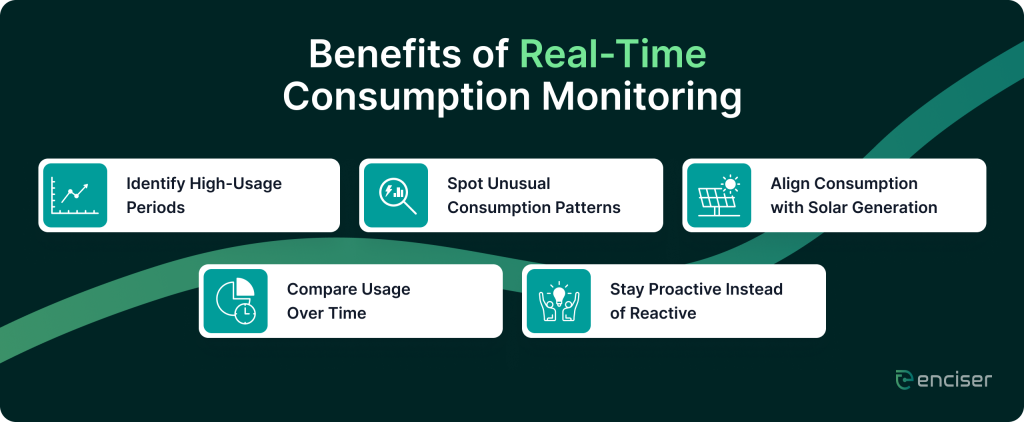
- Identify High-Usage Periods: Live data shows exactly when your electricity use is at its peak. Example: If you see consistent spikes in the evenings when solar is not producing, you can shift certain tasks, such as laundry or water heating, to midday when solar output is highest.
- Spot Unusual Consumption Patterns: A sudden, unexplained rise in usage can point to inefficient appliances, devices left running, or changes in household behaviour. Monitoring helps you address these quickly and avoid unnecessary costs.
- Align Consumption with Solar Generation: When you compare live consumption data with your inverter or net-meter readings, you can fine-tune your usage to match solar-rich hours and reduce dependence on the grid.
- Compare Usage Over Time: Tracking daily, weekly, or monthly consumption trends helps measure the impact of behavioural changes or efficiency upgrades and ensures that savings are sustained.
- Stay Proactive Instead of Reactive: Rather than waiting for a high electricity bill to alert you to a problem, real-time monitoring lets you detect and address inefficiencies instantly. This helps you stay in control of your usage and your savings.
How enciser Improves Visibility Into Your Energy Use
Solar panels work best only when you know what’s happening between the installation day and the monthly bill. In most cases, we rely on the electricity bills to find out if solar panels are bringing any actual benefits or savings. And this is where a smart alternative exists: enciser’s Emerald.
By connecting Emerald to your solar setup, you can:
- Monitor live household electricity consumption in real time
- Spot unusual consumption spikes and high-use periods during the day
- Set consumption alerts when usage exceeds your chosen thresholds
- Review consumption trends over time to identify waste and plan load shifts to solar-rich hours (using your inverter/net-meter app for generation/export data)
Here’s a glance at enciser’s Emerald and the ways it helps you keep your solar panels performing at their best:
- Track live household electricity consumption
- Visual dashboards showing when and how power is used
- Alerts for unusual consumption spikes or prolonged high-use periods
- Pair enciser energy consumption data with your inverter/net-meter app to understand generation/export
- Compare past vs. current consumption to spot waste and shift loads to solar-rich hours
- Support smarter use of net metering (where applicable) by using Enciser alongside net-meter/inverter data
Think of Emerald as your energy-use health monitor, always on, always watching, so you don’t miss a beat (or a rupee).
How Much Can You Actually Save With Better Monitoring?
Spending time and effort on effective monitoring doesn’t just help you stay updated and informed about the overall scenario. It can help you spot underperforming solar panels early, which can save you around ₹500–₹1500 per month.
With the easy installation of smart devices like enciser’s Emerald, you can identify waste, reduce unnecessary daytime usage, and adjust habits to shift more loads into solar-rich hours. In many homes, this leads to lower grid draw and higher exports, as reflected in your net-meter/inverter app (where applicable).
Case Study
One of our clients, a homeowner in Ahmedabad, installed a 3 kW rooftop solar panel setup in early 2024. While he expected significant savings, his electricity bills remained higher than projected, averaging ₹2,000/month.
He had no way of knowing how much electricity his household was using during different times of the day and relied solely on his monthly bill to judge performance.
In March 2025, he installed enciser’s Emerald, a smart real-time monitoring device. Within days, enciser’s data showed early-morning and evening spikes. By matching those spikes with his household routine (and inverter logs), he realised heavy-use tasks like laundry and water heating were happening at the wrong time.
By shifting these high-load activities to midday, when his solar panels were producing the most power, he reduced unnecessary grid usage and maximised his self-consumption.
Results: By shifting heavy appliance use to solar-rich hours based on enciser’s data, the homeowner cut daytime grid usage by 35%, increased net-meter exports by 22% (where applicable), and saved about ₹1,200 a month.
Takeaway: Real-time consumption insights turned small habit changes into big savings.

Final Thoughts
If you think installing solar panels is a one-time investment, and once done, you can effortlessly reap its benefits for life, it’s time to think again. For you to have substantial savings from solar energy, proper monitoring and maintenance are crucial to ensure it continues to function at optimal capacity.
Remember this: visibility equals savings. If you have access to real-time consumption analysis, nothing can beat it. A simple step of installing a smart device like Emerald goes a long way. It promotes visibility, brings complete transparency, and guides you towards an ideal consumption pattern even before the actual problem arises.
enciser is a one-stop solution for your electricity-related concerns and works hand-in-hand with your solar installation to help you maximize returns and stay in charge of your electricity bills.
Already have solar? Let’s make sure it’s working for you. Try enciser’s Emerald and track your power like a pro.

 Previous Blog


