
Ever spotted those tiny bulbs labeled “0-watt” and thought, “What a win—light without cost!!”
Well, not exactly. These so-called “0-watt” bulbs actually consume anywhere between 7 to 10 watts. So nope, not free—just a clever name with a hidden cost.
And yet, they glow in every second Indian home—night lamps, pooja corners, fairy lights, you name it.
They’re sold as harmless. Power-free. Bill-friendly.
But your electricity meter won’t be fooled. These little bulbs do add up.
So let’s talk about what these bulbs actually are, how much they quietly add to your bill, and whether they’re as innocent as they seem.
What Is a 0-Watt Bulb, Anyway?
The term “0-watt bulb” sounds cool, but it’s more of a nickname than a fact. Especially in India, it’s commonly used for small bulbs people leave on all the time—in night lamps, corridors, prayer rooms, or just for a soft glow.
Originally, they were those little filament-based incandescent bulbs. And get this: despite the name, they consumed around 10 to 15 watts. Over the years, LED versions came in—far more efficient, using just 0.5 to 1.5 watts. Yet the name stuck.
So no, 0-watt doesn’t mean zero power. It just means very low power. But low isn’t the same as free.
How Much Power Does It Actually Consume?
Let’s put numbers to the name:
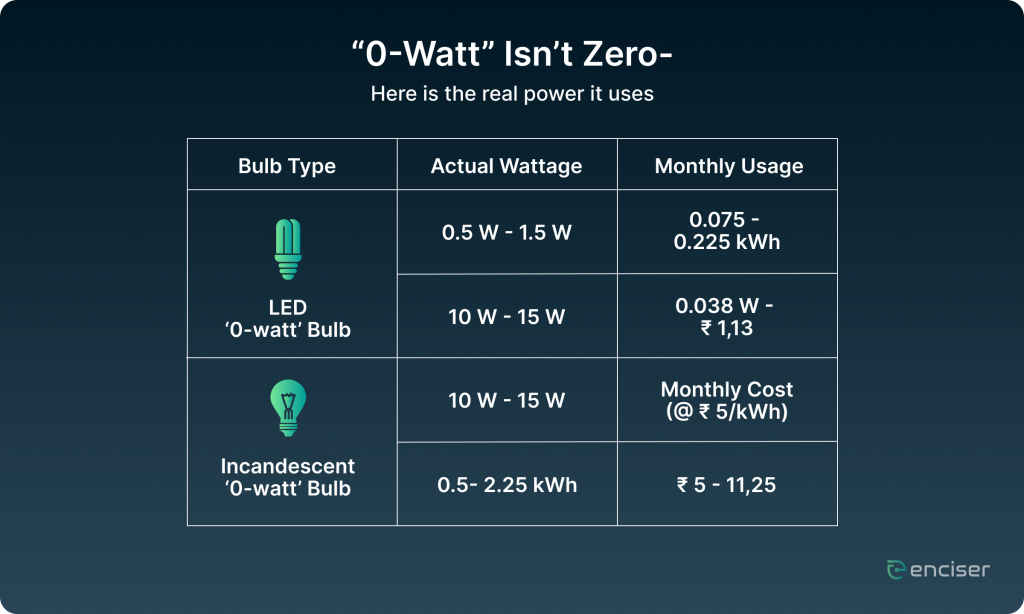
Quick Math: A 1-watt LED bulb used for 5 hours/day = 1 × 5 × 30 = 150 watt-hours = 0.15 kWh/month.
At ₹5 per unit, that’s just ₹0.75 per month.
Not bad? Sure. But what if you have 10 of them running 10 hours a day, every day? That adds up. Fast.
Why the Misleading Name?
So why call it a 0-watt bulb?
Back in the day, brands used the term to simply mean “low power.” It made sense. It was easy for people to understand. And since nobody really checked the exact numbers, it became the norm.
No one’s being evil about it. But yes, it’s definitely a name that misleads—especially in a time when people are genuinely trying to cut down their electricity bills.
Does It Affect Your Electricity Bill?
If you’re using just one LED 0-watt bulb for a couple of hours each night, you probably won’t notice it on the bill. But here’s a quick mental check:
Got 10 of these bulbs at home?
Run them 12 hours a day?
Each bulb uses 1 watt?
That’s 10 × 1W × 12h × 30 days = 3.6 kWh/month.
At ₹5 per unit, that’s ₹18 every month—just from those small glowy bulbs.
Still using old-school incandescent ones? That could be over ₹120. Yep, not zero anymore.
Smarter Alternatives That Actually Make Sense
Sure, a so-called “0-watt” bulb won’t skyrocket your bill, but when you’re running one in every room, every night, it adds up. And here’s the thing: there are better options out there that do the same job, without the fuzzy math.
Here’s how to make a smarter switch:
Pick LED bulbs with actual wattage labels.
Look for bulbs that clearly say 0.5W, 1W, or 3W. Skip anything that hides behind vague names like “0-watt” without specifics.
Don’t go by watts alone—check lumens.
Lumens tell you how bright the bulb is. A 1W LED can be brighter than a 10W filament bulb, and far more efficient.
Add timers or smart plugs.
Especially useful for night lamps, pooja corners, or fairy lights. Set them to turn off after a few hours—you’ll save energy without lifting a finger.
Choose reputable brands.
Reliable brands list accurate specs and often carry energy-saving certifications. Unbranded options might cut corners—and eat up more power than promised.
The point isn’t panic—it’s awareness. If you’re lighting up your home anyway, you might as well do it with bulbs that are honest, efficient, and built for the long run.
Track It Yourself—Don’t Guess
You can take a guess at how much electricity your bulbs use. Or, you can see it in real time.
That’s where Enciser’s Emerald comes in. It shows your actual electricity usage. With Emerald, you can:
Spot silent power leaks
Understand your daily patterns
Take control of your bill
Even those so-called 0-watt bulbs leave a trace. Because when it comes to electricity, there’s no such thing as invisible.
Final Word: A Bright Idea Isn’t Always Energy-Free
0-watt bulbs are clever in name, soft in glow, but not exactly free.
The more you understand what they actually use, the better choices you can make. Swap to efficient lights. Use tools like Emerald to track your power. And most importantly, stop trusting labels blindly.
Because in today’s world, being smart about electricity isn’t just good for your bill. It’s good for the planet too.

 Previous Blog
