India’s solar potential is unmatched.
The country receives over 5,000 trillion kilowatt-hours (kWh) of solar radiation every year—making it one of the most sun-rich countries in the world. With this kind of natural advantage, it’s no surprise the nation is aiming high: 280 GW of solar capacity by 2030, as part of a larger 500 GW clean energy goal.
So, what’s fueling this momentum? A powerful mix of government-backed incentives, next-gen solar tech, and rising demand from industries that want sustainable, scalable power—and fast. For businesses, it’s not just about going green anymore—it’s about getting smart, staying future-ready, and tapping into a growing market that’s only moving forward.
Before going any further, let’s see where we started!
India’s Solar Manufacturing Journey (2010–2030)
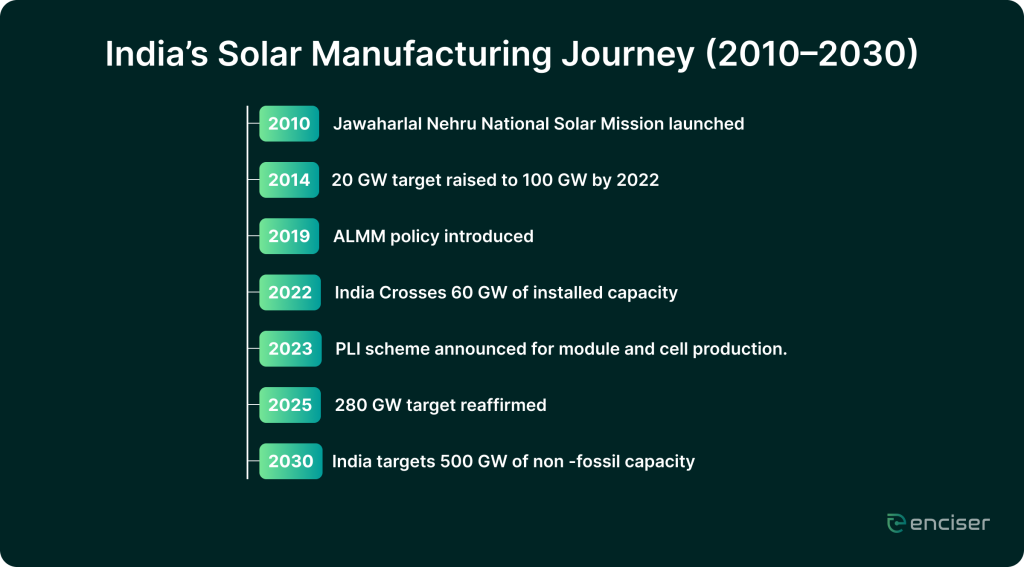
India’s solar manufacturing journey has been nothing short of remarkable—fueled by smart policy, fast growth, and global ambition.
It all began in 2010 with the Jawaharlal Nehru National Solar Mission, laying the foundation for clean energy adoption. Just four years later, India raised its solar target from 20 GW to a bold 100 GW by 2022, showing the world it meant business.
Then came the game-changers:
In 2019, the Approved List of Models and Manufacturers (ALMM) was introduced—bringing quality control and trust to the sector. By 2022, India crossed the 60 GW milestone in installed solar capacity. And in 2023, the government rolled out the PLI scheme, giving financial incentives to boost domestic production of solar cells and modules.
Now in 2025, the solar sector is scaling faster than ever—charging toward the 280 GW mark with manufacturers expanding aggressively. Looking ahead to 2030, the vision is clear: 500 GW of non-fossil fuel energy, with solar leading the charge in India’s energy transformation.
Top 10 Solar Panel Manufacturers in India

1. Tata Power Solar Systems Ltd.
Headquarters: Bengaluru, Karnataka
Manufacturing Capacity (2025): 4.3 GW (Modules + Cells)
With over 30 years in the solar game, Tata Power Solar is one of the most trusted names in India’s clean energy space. A subsidiary of Tata Power, it brings strength not just in manufacturing, but also in EPC execution at scale.
Its latest 4.3 GW vertically integrated plant in Tamil Nadu marks a major step forward—perfectly aligned with India’s “Make in India” push for domestic manufacturing.
What sets Tata Power Solar apart?
- High-efficiency modules, including mono PERC and bifacial
- 1.4+ GW of rooftop installations and 11 GW of utility-scale installations
- A reputation built on quality, reliability, and wide project expertise
Whether it’s government tenders or commercial installations, Tata Power Solar continues to be a go-to choice for large-scale, bankable solar solutions.
2. Adani Solar
Headquarters: Ahmedabad, Gujarat
Manufacturing Capacity (2025): 4 GW (targeting 10 GW by 2026)
Adani Solar, part of the Adani Group, is India’s first and largest fully vertically integrated solar manufacturer—producing everything from polysilicon to modules. Since launching in 2016, it has grown rapidly, serving both utility and rooftop segments.
Its manufacturing operations are backed by automated, high-throughput production lines with global certifications. With plans to scale to 10 GW by 2026, Adani is positioning itself as a global solar leader.
What makes Adani Solar stand out?
- End-to-end vertical integration from raw materials to finished modules
- High-performance mono PERC and TOPCon modules
- Strong presence in both utility-scale and rooftop markets
- Aggressive capacity expansion aligned with national solar goals
3. Waaree Energies Ltd.
Headquarters: Mumbai, Maharashtra
Manufacturing Capacity (2025): 15 GW (Modules), 5.4 GW (Cells)
Founded in 1989, Waaree Energies is India’s largest module manufacturer by volume. It offers a broad product portfolio including mono, poly, bifacial, and flexible modules through its advanced plants in Surat and Umbergaon.
Beyond manufacturing, Waaree also provides EPC, project development, and O&M services, making it a full-spectrum solar partner.
Why Waaree leads the pack:
- Top-ranked module shipments in Q1 2025 (JMK Research)
- Exports to over 68 countries worldwide
- Offers turnkey EPC and O&M services
- Trusted by developers and contractors for quality and scale
Stand out from other solar sellers. Add real-time tracking with Enciser Emerald Electricity Advisor and give your customers a smarter, more valuable solar setup.
4. Vikram Solar
Headquarters: Kolkata, West Bengal
Manufacturing Capacity (2025): 4.5 GW
Vikram Solar is one of India’s most established solar manufacturers, known for delivering projects across 30+ countries. Its state-of-the-art module line in Tamil Nadu ensures advanced production capabilities.
Key strengths of Vikram Solar:
- Wide product lineup: mono, poly, bifacial, and smart modules
- Strong R&D and performance in harsh climates
- Focus on large-scale exports and government collaborations
- Reputation for long-term reliability in global markets
5. RenewSys India Pvt. Ltd.
Headquarters: Mumbai, Maharashtra
Manufacturing Capacity (2025): 5.5 GW (Modules), 2.5 GW (Cells)
RenewSys is India’s first integrated manufacturer of solar modules and key components like encapsulants, backsheets, and PV cells. Its backward integration gives it unmatched quality control and consistency.
Why developers trust RenewSys:
- ALMM-listed and IEC-certified modules
- Strong utility and rooftop presence across 40+ countries
- Full-stack manufacturing for better quality assurance
- Focused on reliable supply chain and consistent performance
6. Goldi Solar
Headquarters: Surat, Gujarat
Manufacturing Capacity (2025): 3 GW (targeting 14 GW by FY26)
Goldi Solar is a fast-scaling Indian manufacturer focused on premium-quality modules. The brand is investing aggressively in module and cell lines to achieve vertical integration by 2025.
What sets Goldi apart:
- Manufacturer of mono PERC, bifacial, and multi-busbar modules
- Export-quality standards and rapid deployment
- Tailored for utility and commercial-scale installations
- Known for excellent execution timelines and customer service
7. Saatvik Green Energy Pvt. Ltd.
Headquarters: Ambala, Haryana
Manufacturing Capacity (2025): 3.8 GW
Saatvik Green Energy has become a strong player in the ALMM-compliant module segment. It specializes in high-efficiency mono PERC and bifacial modules produced on automated lines.
Saatvik’s B2B strengths:
- Fast delivery and customizable module offerings
- Strong participation in government and utility projects
- Trusted by EPCs for time-sensitive projects
- Set to enter global markets by late 2025
8. Rayzon Solar
Headquarters: Surat, Gujarat
Manufacturing Capacity (2025): 4 GW (targeting 12 GW by Sept 2025)
Rayzon Solar is one of India’s fastest-growing solar manufacturers, focused on delivering high-yield solutions using modern technologies.
Rayzon’s key highlights:
- Focused on TOPCon and bifacial module technologies
- Targeting 12 GW production by the end of 2025
- Positioned for large-scale projects across India and Southeast Asia
- Emerging as a strong alternative for high-volume B2B procurement
9. Loom Solar Pvt. Ltd.
Headquarters: Faridabad, Haryana
Manufacturing Capacity (2025): 100 MW
Loom Solar stands out for its specialization in residential and SME-focused solar products. It offers a range of D2C-ready solutions, from panels to complete solar kits.
Why Loom Solar appeals to small-scale buyers:
- Mono PERC panels, microinverters, lithium batteries
- Strong online and digital-first presence
- PAN India delivery and installation network
- Ideal for plug-and-play solar applications
10. SolarAce Energy
Headquarters: Noida, Uttar Pradesh
Manufacturing Capacity (2025): ~500 MW (estimated)
SolarAce Energy is gaining traction as a reliable choice in the mid-sized EPC and rooftop segment. With a strong customer-service focus, it delivers high-efficiency, ALMM-approved modules.
Why SolarAce is worth watching:
- Cost-effective mono and bifacial module offerings
- Agility in handling customized B2B projects
- Scalable pricing for commercial and institutional clients
- Focused on growing regional partnerships through 2026
Looking to increase your solar panel pricing? Add Enciser Emerald Electricity Advisor as a value add-on and show customers the extra they’re getting.
Ranking Criteria Explained
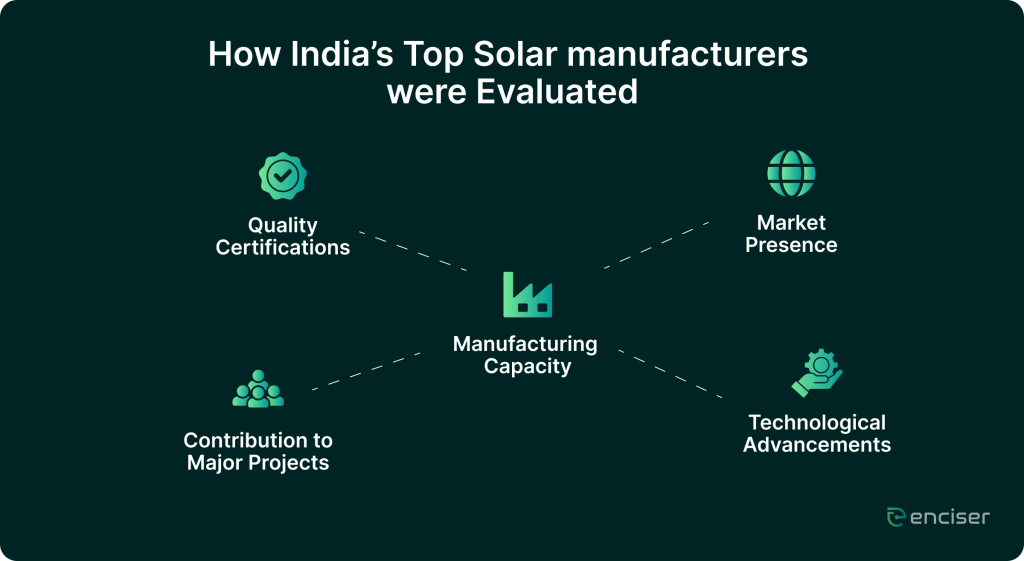
The ranking of solar panel manufacturers in India is based on five key parameters that reflect both production capability and industry impact:
Manufacturing Capacity
It indicates the total annual capacity to produce solar modules and cells. Higher capacity reflects the ability to handle large-scale demand, support export volume, and ensure supply chain stability.
Technological Advancements
It evaluates the adoption of modern technologies such as mono PERC, TOPCon, and bifacial modules. Continuous innovation contributes to improved panel efficiency, durability, and long-term performance.
Market Presence
It assesses the company’s operational footprint—both domestic and international. A broad presence signals scalability, distribution strength, and adaptability across diverse markets.
Quality Certifications
It includes adherence to certifications like BIS, ALMM, IEC, and ISO. These benchmarks confirm compliance with industry standards, ensuring product reliability and eligibility for institutional projects.
Contribution to Major Projects
It considers involvement in utility-scale, government, or international solar installations. Execution of large, high-stakes projects demonstrates technical capability, delivery reliability, and operational maturity.
Understanding the Different Types of Solar Modules
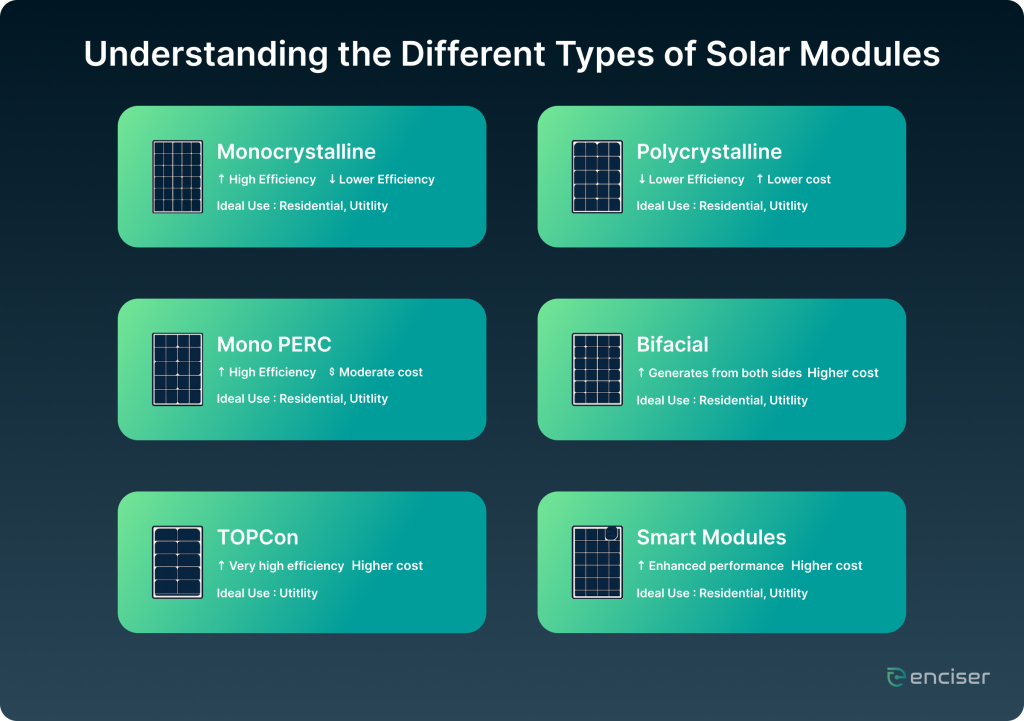
Solar modules aren’t one-size-fits-all. Different technologies offer varying benefits in terms of efficiency, cost, and application.
Here’s a quick overview of the most widely used module types in India’s solar market:
Monocrystalline
Monocrystalline modules are high-efficiency, sleek-looking panels that perform exceptionally well in limited-space installations. They are best suited for residential rooftops and premium commercial projects where maximum output is needed from a smaller area.
Polycrystalline
Polycrystalline modules offer a more cost-effective solution, though with slightly lower efficiency compared to monocrystalline panels. They are widely used in utility-scale setups and budget-conscious solar projects.
Mono PERC
Mono PERC (Passivated Emitter Rear Cell) modules are an enhanced version of monocrystalline technology. They deliver improved energy yield, especially in low-light conditions, making them ideal for both residential and commercial installations.
Bifacial
Bifacial modules are designed to capture sunlight from both the front and rear surfaces, increasing energy output. They are ideal for high-reflectivity environments and ground-mounted utility-scale systems.
TOPCon
These solar modules are one of the latest technologies offering ultra-high efficiency and long-term reliability. Gaining popularity in large-scale commercial and industrial installations.
Smart Modules
Smart modules come integrated with power optimizers or microinverters, enabling enhanced monitoring, performance, and shade tolerance. These are ideal for residential rooftops and complex layouts where shading or irregular surfaces are a concern.
Each module type is designed for a specific purpose—understanding the difference helps buyers optimize both cost and energy output.
Conclusion
India’s solar manufacturing landscape is vibrant and rapidly evolving, driven by technological advancements, supportive policies, and a growing demand for clean energy. The top manufacturers listed above play a pivotal role in propelling the nation towards its renewable energy targets.
Their commitment to quality, innovation, and sustainability not only strengthens India’s position in the global solar market but also contributes to a greener and more sustainable future.
Enciser for Smarter Solar Savings

Going solar is a smart move—but to make the most of it, you need to know how your energy is being used. That’s where Enciser comes in.
Enciser’s Emerald is a real-time electricity tracking device that helps solar users monitor their power consumption and savings with precision. Whether you’re checking if your panels are performing efficiently or trying to optimize your usage, Emerald gives you complete visibility, control, and savings.
Because when it comes to solar, installation is just the beginning.
Pair your panels with Enciser’s Emerald to unlock real-time tracking, better energy decisions, and long-term savings.
FAQs
1. What is the ALMM, and why is it important for solar buyers?
2. How do I check if a solar panel brand is ALMM-approved?
3. What are the differences between monocrystalline, polycrystalline, and bifacial solar panels?
4. Which solar panel type is best suited for residential use in India?
5. What factors should I consider when choosing a solar panel manufacturer?

 Previous Blog